
Figure skating jumps and spins: all 6 jumps in order
The different jumps in figure skating, explained: six jumps from single to quad, four spin positions and their combinations, and what we measure on each.
Free: 2 video breakdowns and 20 messages to Mila. The first breakdown needs no sign-up.
- jumps, single to quad
- 6
- spin positions + combinations
- 4
- the jump ladder, up to the quad Axel
- 4A
Toe jumps and edge jumps
Figure skating has six jumps. Three are toe jumps: the skater taps the ice with the toe pick of the free foot to vault up (toe loop, flip and Lutz). Three are edge jumps: the skater takes off straight from the edge of the blade (Salchow, loop and Axel). Every jump lands backward on one foot.
| Jump | Type | Take-off | Landing |
|---|---|---|---|
| Toe loop TToe jump | Toe jump | right back outside edge, with the left toe pick | right back outside edge |
| Salchow SEdge jump | Edge jump | left back inside edge | right back outside edge |
| Loop LoEdge jump | Edge jump | right back outside edge | right back outside edge |
| Flip FToe jump | Toe jump | left back inside edge, with the right toe pick | right back outside edge |
| Lutz LzToe jump | Toe jump | left back outside edge, with the right toe pick | right back outside edge |
| Axel AEdge jump | Edge jump | left forward outside edge | right back outside edge |
The edges are technique for a skater who turns counter-clockwise; for clockwise it’s the mirror image. Mila tells the jumps apart by the entry and the movement.
Figure skating jumps list
All six types of figure skating jumps, from the easiest to the hardest. We recognize a jump by how the skater goes into it and whether they use the toe pick.
Toe loop (T)
Toe pickSkating backwardHow to spot it
The simplest toe jump: gliding backward, the skater taps the ice behind with the other foot’s toe pick and vaults up.
Codes: 1T · 2T · 3T · 4T
More about this jump: Toe loopSalchow (S)
No toe pickSkating backwardHow to spot it
No toe pick, usually right after a turn from forward to backward. The free leg swings through, and the skater lands on the other foot.
Codes: 1S · 2S · 3S · 4S
More about this jump: SalchowLoop (Lo)
No toe pickSkating backwardHow to spot it
No toe pick and no swing: the legs stay close, almost crossed, and the skater takes off and lands on the same foot.
Codes: 1Lo · 2Lo · 3Lo · 4Lo
More about this jump: LoopFlip (F)
Toe pickSkating backwardHow to spot it
A toe jump usually entered straight from a turn (a three-turn or mohawk), with a short glide before the toe pick.
Codes: 1F · 2F · 3F · 4F
More about this jump: FlipLutz (Lz)
Toe pickSkating backwardHow to spot it
A toe jump after a long backward glide, often from the corner of the rink, with no turn right before the take-off.
Codes: 1Lz · 2Lz · 3Lz · 4Lz
More about this jump: LutzAxel (A)
No toe pickSkating forwardHow to spot it
The only competition jump that takes off forward, so it has an extra half rotation: a single Axel is 1½ rotations, a double is 2½.
Codes: 1A · 2A · 3A · 4A
More about this jump: Axel
- Skating backward
- Skating forward
- Toe pick
- Take-off
Combinations: we break down one jump at a time and mark it as part of a combination.
ISU base values of the jumps
How many points a jump with all its rotations is worth before the judges’ marks (GOE), from the ISU Scale of Values for the 2026/27 season (ISU Communication 2786).
| Jump | Single | Double | Triple | Quad |
|---|---|---|---|---|
| Toe loop | 1T 0.40 | 2T 1.30 | 3T 4.20 | 4T 9.50 |
| Salchow | 1S 0.40 | 2S 1.30 | 3S 4.30 | 4S 9.70 |
| Loop | 1Lo 0.50 | 2Lo 1.70 | 3Lo 4.90 | 4Lo 10.50 |
| Flip | 1F 0.50 | 2F 1.80 | 3F 5.30 | 4F 11.00 |
| Lutz | 1Lz 0.60 | 2Lz 2.10 | 3Lz 5.90 | 4Lz 11.50 |
| Axel | 1A 1.10 | 2A 3.30 | 3A 8.00 | 4A 12.50 |
Figure skating spins
The three basic figure skating spin positions (upright, sit and camel) and the layback, an upright spin leaning back. A position counts when it’s held for at least 2 revolutions.
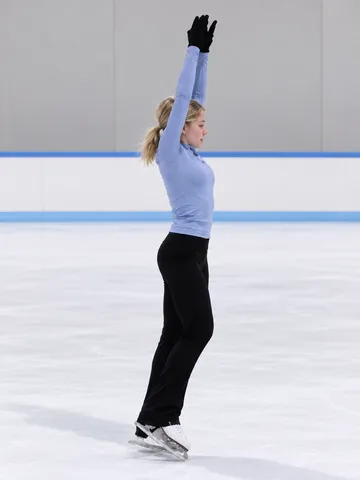
Upright spin
USpStanding on a straight or slightly bent leg.
More about this spin: Upright spin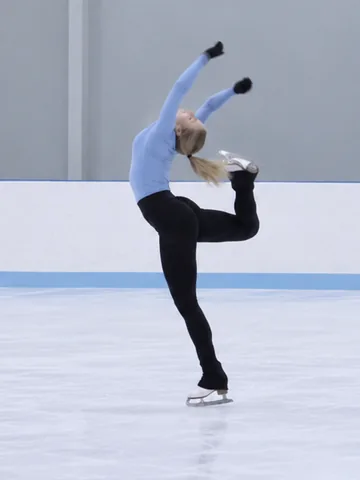
Layback spin
LSpAn upright spin with the upper body leaning back or to the side.
More about this spin: Layback spin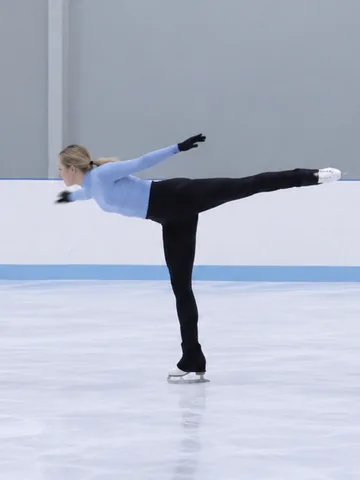
Camel spin
CSpFree leg back above hip height, upper body close to horizontal.
More about this spin: Camel spin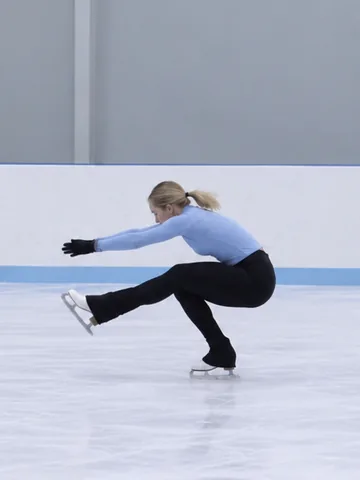
Sit spin
SSpSitting low: the supporting thigh at least parallel to the ice.
More about this spin: Sit spin
Spin codes in your breakdown
- USp · LSp · CSp · SSp
- One position
- CoSp
- Combination spin: two or more positions
- F…
- Flying entry, e.g. FCSpBeta
- C…
- Change of foot, e.g. CCoSpBeta
What we measure
| Measurement | Jumps | Spins |
|---|---|---|
| Element and its code | Yes | Yes |
| Rotations / revolutions per position | Yes | ≈ About |
| Air time (on the Progress page) | When clear | No |
| Landing: landed, fall, hand down | Yes | No |
| Arms in the air (doubles and up) | When clear | No |
| Body lean in the air | When clear | No |
| Positions held (2+ revolutions) | No | Yes |
| Sit depth, camel leg height | No | Beta |
| Travel across the ice | No | Steady phone |
| Phases and key frames | Yes | Yes |
| Main thing to fix and exercises for it | Yes | Yes |
Questions
Does it count quads?
What are the figure skating jumps in order of difficulty?
What is the hardest figure skating jump?
What is the easiest figure skating jump?
What are the types of figure skating spins?
How do you tell figure skating jumps apart?
Why do skaters “pop” a jump?
What is a jump combination?
What does under-rotated mean?
What are spin levels?
Still have a question? Write to us: info@skateassistant.ai
Try it on your own video
Film one jump or spin and get your breakdown.
Free: 2 video breakdowns and 20 messages to Mila. The first breakdown needs no sign-up.